

Single point of contact: top xRM integrates CRM systems
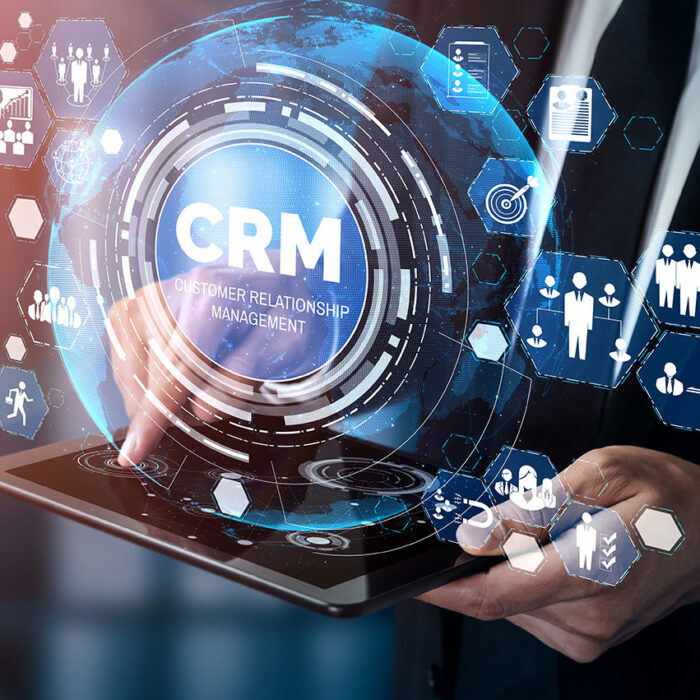
With top xRM, companies get a 360-degree view of customers and other contacts.
How top xRM enables a 360-degree view of customers and other contacts
The situation used to be fairly straightforward: in addition to the ERP system, some (but by no means all) companies used a CRM system to organize their relationships with customers. The software for customer relationship management was primarily used to manage personal data – possibly enriched with interests and hobbies, reservations and no-gos of the contacts. It also stored contact histories, deals and, if applicable, service incidents. Equipped with all of this, sales employees were able to address their customers in a more targeted manner – at least that was the idea.
Nowadays, hardly anyone talks about CRM or customer relationship management anymore. Instead, they talk about CX, which stands for customer experience. This change in terminology is certainly partly due to the zeitgeist. However, a lot has actually happened in terms of solutions. Data is no longer just passively stored. It is also used to actively shape the approach. For example, by curating and sending individual newsletters based on customer profiles. The channels used to interact with customers are also much more differentiated. Telephone calls, emails, letters and fax messages have been joined by a number of messengers and collaboration tools. The result is often a very colorful application landscape. And not just in the B2C context, but also in the B2B context.
WEBINAR
Why digital document management?
Find out how you can shorten throughput times and bring more transparency to your workflows and processes!
Register for the webinar now
Many applications make a consolidated view difficult
The new technological possibilities not only enable sales teams to meet the expectations of demanding customers. Used correctly, they also provide a number of advantages in global competition. And without Microsoft Teams or Zoom Meetings, it would have been much more difficult to drive sales processes forward at all during the coronavirus pandemic. However, there is also a glaring disadvantage: as the number of specific applications increases, so does the difficulty of consolidating all data and documents. The vision of a 360-degree view of the customer is not finally becoming reality – it is moving further away again.
In our opinion, the consequence of this cannot be to limit oneself to one solution in favor of a uniform database. For companies that use SAP, the SAP Sales Cloud is a powerful sales application that can easily be expanded to include the SAP Marketing Cloud, the SAP Service Cloud, the SAP Commerce Cloud and the SAP Customer Data Platform. However, even this extensive portfolio cannot map all of today’s standard sales process functions.
top xRM as an integration layer and leading system
In order to utilize the potential of each individual application and at the same time achieve a consolidated view, it is worth using top xRM. The SAP-based add-on brings together objects from SAP systems as well as data and documents from any application in a file with a defined structure. For example, if an email exchange results in a new lead, this is created in the SAP Sales Cloud and a corresponding entry is automatically created in top xRM at the same time. The objects from the SAP Sales Cloud are then added to this entry. The quotations, calculations, orders, invoices and other documents created in the further course of the process are also saved here, as are Word documents with meeting notes, Excel files with calculations or PDF files with sketches. This ensures that all information about a customer is collected in one place and can be accessed from anywhere at any time.
top xRM can also be used as a leading CRM system. In this case, sales employees create their leads, opportunities and customers directly here. top xRM offers its own CRM file templates for lead and contact management. Of course, the appointments can be synchronized in Outlook and are therefore also available in the calendar.


