

xRM is the new CRM
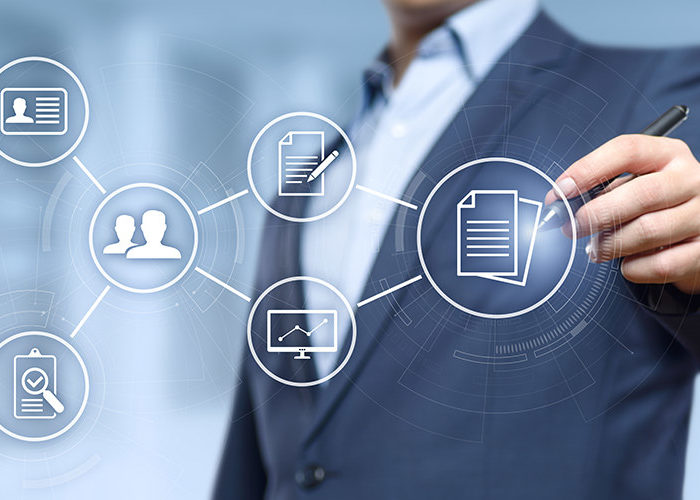
xRM systems can be used to digitize relationships with all of a company's stakeholders and combine the strengths of existing ECM and CRM solutions.
How to digitize all relationships with all stakeholders
In October 2019, the digital association Bitkom published a new study on enterprise content management (ECM) in German SMEs. According to the study, 47% of the companies surveyed manage their documents digitally. This is a significant increase compared to the 2017 study. Back then, only 33 percent used an ECM solution.
Something is also happening in customer relationship management. In 2018, Capterra – a company that provides support in the search for software – found in a survey that 23% of participating SMEs in Germany use software to manage customer relationships. One year later, 32% of respondents said they were already using such software – an increase of 27%.
Need to catch up on the digital foundation
The increase in both areas is generally pleasing. However, the results are also a little alarming from our point of view. After all, they also show that more than half of SMEs are still printing out and transporting vast quantities of paper. And that over two thirds of SMEs do not systematically manage their relationships with customers. So the digital foundation is still far from being laid everywhere – and this at a time when almost everyone is talking about the “Internet of Things” as a matter of course and somehow also offering it. At least it feels that way.
It is also worth noting that ECM and CRM are still more or less isolated from each other. Enterprise content management is primarily the responsibility of the commercial departments, while marketing and sales deal with customer relationship management. Finally, relationships with customers are mapped comparatively frequently, while relationships with suppliers are mapped occasionally. All other stakeholders or objects are hardly ever in the company’s field of vision. This includes, for example, employees, machinery and equipment, contracts and real estate. And much more besides.
WEBINAR
Why digital document management?
Find out how you can shorten throughput times and bring more transparency to your workflows and processes!
Register for the webinar now
xRM as an enabler of digital transformation
Back in the 1990s, Extended Relationship Management (XRM) was discussed as a concept that was intended to represent all possible relationships between a company and its environment. Unlike CRM, however, XRM never really caught on. For a few years now, the term has been appearing more frequently again. This time, however, with a small x. xRM is now called Anything Relationship Management and basically has the same claim as it did over 20 years ago. The only difference is that logic, technologies and best practices from the CRM world can now be used and transferred to all kinds of other relationships.
If this idea is taken to its logical conclusion, we believe there is no way around fully digitizing and integrating content, processes and workflows. This makes xRM an important enabler and driver of digital transformation. Why this is the case is best illustrated by an example. For example, the connection between a company and a customer.
Relationships, documents and processes
First of all, the relationship exists merely as a construct that is continuously filled with life. This usually begins with the company recording the master data for a customer – including the company name, customer number, address, contact person and contact details. The ERP system is usually used for this. However, documents that cannot be recorded there – and not always in the CRM system – may already play a role at this stage. These might be the general terms and conditions or a framework agreement. Companies then either store these in a digital folder on the server (or, if things go badly, only locally on a computer) or they actually staple the printout to an analog file.
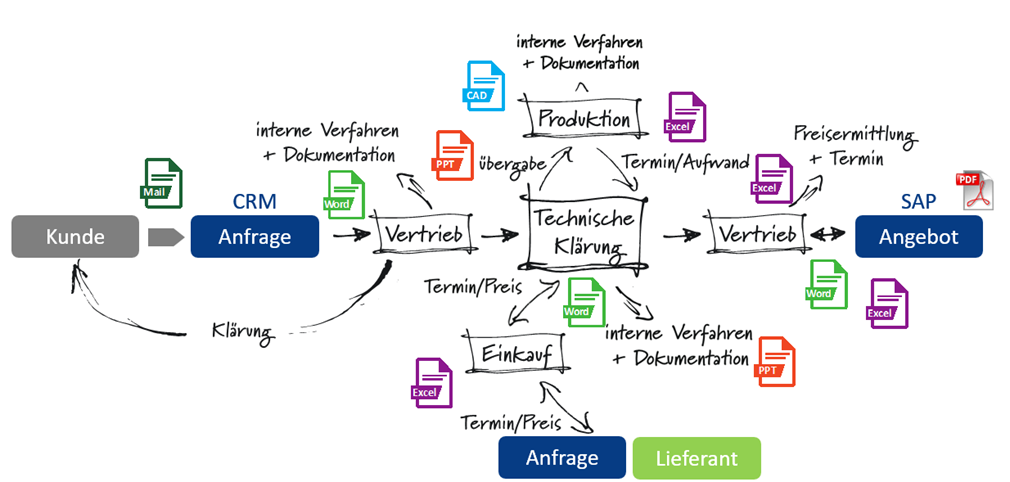
Up to this point, the relationship between the company and the customer has been static. It becomes dynamic the moment processes take place between them. Such a process is initiated, for example, when the potential customer asks the sales department for a quote for a new system. Sales then records the requirements and first coordinates internally: with Technical Clarification on the customer’s specific wishes, with Production on a deadline and with Purchasing on the prices for purchased components. Only when all the information is available can the sales department prepare an offer and send it to the potential customer after approval by a higher authority. This is followed by an iterative back and forth between the potential customer and the sales department as well as between the sales department and the various specialist departments. Until at some point a decision is made, the system is ordered and delivered, the invoice is issued by the accounting department and receipt of payment is confirmed.
Digitize your customer relationship management with top xRM.
This entire sales process consists of an extremely large number of individual processes that are logically related to each other and for which a great deal of information is generated. Some of this information is mapped by the ERP system. But not all of it. Orders, invoices and other documents can be exchanged from ERP system to ERP system via EDI. However, the fact that companies and customers are able to do this is not necessarily the standard. Other information is almost never transmitted in this way, but is exchanged as a Word or Excel file, as a CAD or PDF document, as an image, video or audio recording.
Collaboration, document management and workflow management
For this reason, a good xRM system should combine the strengths of ECM and CRM solutions and go one step further. It should enable collaboration for all conceivable relationships within a company and provide document management and workflow management. And to do this, it should digitally merge all information and functions that arise along a business process. This also means that the xRM system should be seamlessly integrated into the existing ERP system – which in Germany very often comes from SAP. This is the only way, for example, that a customer’s master data can be linked to the sketches of the ordered system and the faxed invoice and systematically stored. Once this integration is in place, a digital end-to-end process is created. And that means less effort, more speed and higher quality for everyone involved.


