

SAP integration vs. interface
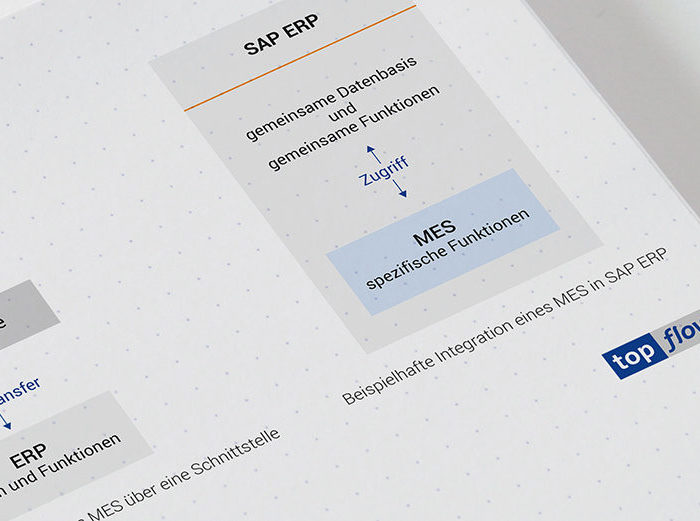
top MES and top XRM can be easily integrated into SAP landscapes.
DMS, ECM and BDE, xRM, MES
and ERP. Many a CIO might feel reminded of the Fanta4 song from time to time – and that “sincerely!” Because the world of corporate IT is made up of a multitude of three-letter abbreviations. Or rather: the systems that are referred to by these abbreviations. The individual applications each perform a specific task, are located in a business unit and are associated with a value creation step. Nevertheless, they should be connected to each other and data should flow between them as freely as possible. The goal is a consistent system landscape. The ERP system is usually at the center of this – this is where the digital threads come together. This raises the question for companies of how to connect their other third-party applications to the ERP system and how best to weave their digital threads. This depends largely on the ERP system. And in many cases, this comes from SAP.
Examples of seamlessly integrated SAP add-ons:
top MES: the Manufacturing Execution SystemSeamlessly integrable, certified for SAP and ready for the
|
top xRM: the enterprise content management systemDigital business processes that can be seamlessly integrated into an existing SAP landscape
|

SAP interface or SAP integration: the type of connection makes a difference
There are basically two answers to this question. The third-party application can be connected via an SAP interface. Or the respective application can be integrated into SAP ERP.
SAP interfaces are required if a system is not based on SAP technology. Data must then be exchanged with each other. The interface has the task of managing communication: receiving data from the ERP system, processing it so that the connected system can understand it and then forwarding it. And vice versa. With genuine SAP integration, such a transfer is not necessary because the integrated application is embedded directly in SAP ERP and can therefore also access its database directly.
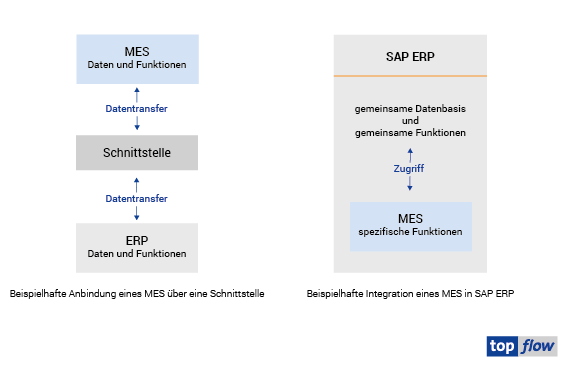
Technologically, the connection via an SAP interface differs considerably from direct SAP integration. Linguistically, however, both options are often equated – as the integration of a new solution or a new application in SAP ERP. However, making a clear distinction here is much more than semantic correctness. Whether a system is connected to SAP ERP in one way or the other has very practical consequences.
SAP interface: double data storage and double effort
Because the data is transferred when using SAP interfaces – and is therefore available redundantly – systems connected in this way also function without direct access to SAP ERP. This is advantageous, for example, if the ERP system and the third-party system are to be operated completely independently of each other. One possible reason: the data connection to a remote area cannot be established with sufficient stability and the branch office must therefore work on its own local system. If the connection between the central ERP system and the local application is interrupted, the third-party system continues to work with the most recently transmitted data. Synchronization takes place later. However, only a more or less long period of time can be bridged in this way – the autonomy is therefore only temporary.
WEBINAR
Why digital document management?
Find out how you can shorten throughput times and bring more transparency to your workflows and processes!
Register for the webinar now
Problems when using SAP interfaces
Otherwise, redundant data storage and time-delayed transmission are problematic. This is mainly because data inconsistencies can occur again and again, preventing optimal decisions: SAP ERP may then assume that there is currently no free capacity in production because the third-party system on site has not yet reported back the current status and does not send any new orders to the store floor. However, the machines are actually already waiting for jobs again and are at a standstill.
Another disadvantage is that SAP interfaces require considerable effort. They not only have to be programmed when a new system is implemented. Modifications to the interface are also required every time SAP ERP or the implemented application needs to be updated or functionally expanded. The search for errors is also time-consuming. This is because it is usually not possible to tell from the visible incidents whether the source lies with SAP ERP, the SAP interface or the connected system.
After all, the applications themselves pose a challenge for many companies because they are a technological black box: The code is usually not transparent and cannot always be changed. And even if this is possible, there is almost always a lack of employees in the IT department who are proficient in the respective programming language.
WEBINAR
Establishing transparent production processes
Find out how you can bring more transparency to your production and uncover optimization potential.SAP integration: the only way to map end-to-end processes
To make a long story short: All the disadvantages of the interface variant are clear advantages with the variant via SAP integration. There is only one database that SAP ERP and all integrated applications can access. This means that there can be no inconsistencies. What’s more, business processes are anchored in SAP ERP in many, very often central locations and linked to its data and functions. Systems integrated into SAP can use these existing SAP functions and data directly. Developing and maintaining redundant functions is therefore just as unnecessary as maintaining redundant data. The support requirements and the associated costs are extremely low, as the application, customizing and development run in the familiar environment.
In the past, SAP’s technology placed fairly strict limits on the design of user interfaces. The user-friendliness of applications was therefore regularly criticized – and in some cases rightly so. Now, however, the use of modern HTML5 technologies (SAP Fiori) means that the possibilities for designing user interfaces are much more diverse
So it’s better to consider SAP integration and connection when selecting software
So there is a lot to be said for the genuine integration of an application in SAP ERP. The fact that there are still many systems in use that have to be connected via an interface probably has a decisive reason: the choice of these applications is greater than for SAP-based solutions. Firstly, because many third-party system providers do not develop explicitly for a specific ERP system in order to be able to address the largest possible sales market – “one size fits all”, so to speak. And secondly, because the design and programming of software that can be integrated requires very in-depth knowledge of the SAP system, SAP processes and the sometimes industry-specific characteristics and requirements.
It is not uncommon for specialist departments to tend towards a third-party solution that cannot be integrated. This is because the software seems to fit the requirements directly in terms of functionality and look and feel. However, this assessment ends at the boundaries of their own department. What is the best way forward for the company as a whole and how the decision affects the interaction of all systems involved is not taken into account.
You might also be interested in…
E-book: How to make your processes fit for digitalization
Digitalization makes company processes more efficient. However, this only applies if the processes are already running smoothly beforehand. In the e-book “Digitize processes – and optimize them in the process”, you can read how to put your existing processes to the test and improve them.



