

SAP and production – a special relationship
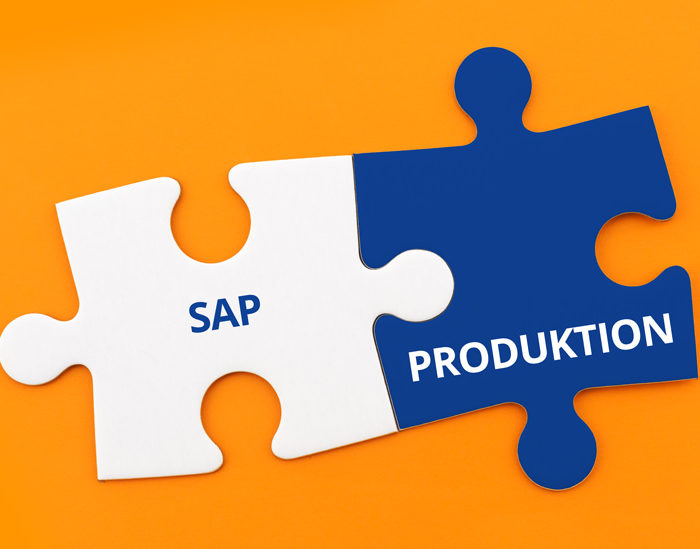
A manufacturing execution system can be used to digitize production - within an existing SAP landscape.
This assessment is unlikely to provoke any contradiction: SAP has been the world’s leading provider of business software for decades. The applications for the commercial and administrative white-collar world are often the benchmark against which the market is oriented. In contrast, SAP has always struggled with the blue-collar world. For a long time, the Walldorf-based company did not even offer a special solution for use on the store floor. Only a few functions in the ERP system were suitable for planning and execution in production. This has since changed. In 2008, SAP acquired the US software provider Visiprise. Since then, its manufacturing execution system has been available to industrial companies under the name SAP Manufacturing Execution (SAP ME). SAP Manufacturing Integration and Intelligence (SAP MII) manages the data exchange between the machines and systems on the one hand and the ERP system on the other in conjunction with SAP Plant Connectivity (SAP PCo). And SAP Supply Chain Management (SAP SCM) – also known as SAP Advanced Planning and Optimization (SAP APO) – can be used for production planning.
More offers in the production environment
In the recent past, SAP has once again increased its involvement in the production environment – which is not surprising given the ongoing debate about Industry 4.0 and the Internet of Things. After all, if the forecasts are even halfway accurate, there is enormous potential here. One example of SAP’s efforts is the SAP Asset Intelligence Network (SAP AIN), which was launched in 2016. The cloud-based platform is designed to enable plant operators, manufacturers and service providers to exchange data – from operating and maintenance instructions, specifications and spare parts lists to sensor data on the current status. SAP is bundling its entire IoT portfolio under the SAP Leonardo brand. Here, companies can find big data and connectivity applications that can be used to network products, machines and systems as well as the entire infrastructure. SAP – it can be speculated – is likely to see itself today as one of the leading players in the production environment.
WEBINAR
Establishing transparent production processes
Find out how you can bring more transparency to your production and uncover optimization potential.
Register for the webinar now
SAP competes with niche MES providers
Manufacturing companies currently see things differently. So far, SAP does not seem to be their first choice when it comes to supporting processes on the store floor. In our opinion, there is a key reason for this: SAP’s portfolio currently includes all the technologies required to implement a large number of conventional and Industry 4.0 scenarios. However, some users consider the offering to be very complex and implementation is therefore associated with a great deal of effort and corresponding costs. For many medium-sized companies in particular, SAP is therefore not an option for production – even though an ERP system from SAP is almost always in use. Instead, they rely on a manufacturing execution system from a specialized niche provider and connect it to the commercial system world via interfaces – with all the disadvantages that such a pseudo-integration entails.
Solution from SAP partner is an alternative
An interesting change in SAP strategy is now emerging in the area of production planning: In the real-time ERP suite SAP S/4HANA, some planning functions from SAP APO are already directly integrated and therefore easy to use. Further planning features are being developed and successively added to SAP S/4HANA. The production planning world is therefore merging with the ERP world. However, SAP ME will remain the only option for execution in the future – at least the only solution offered directly by SAP.
However, there is also an extremely smart alternative based on original SAP technology: as an SAP partner, we are developing an ME application that has been certified by SAP itself and can be seamlessly integrated into the existing SAP system landscape. On the one hand, this radically reduces complexity and costs. On the other hand, all data and functions stored in the ERP system are available without interfaces – as well as all the possibilities of modern vertical integration. This makes recording machine data and operating data child’s play. What’s more, the application not only runs under SAP ERP, but also under SAP S/4 HANA. This results in an extremely exciting symbiosis of conventional ERP functions, production planning and optimization as well as MES functions.
You might also be interested in…
E-book: How to make your processes fit for digitalization
Digitalization makes company processes more efficient. However, this only applies if the processes are already running smoothly beforehand. In the e-book “Digitize processes – and optimize them in the process”, you can read how to put your existing processes to the test and improve them.



