

Transparent processes with BPM
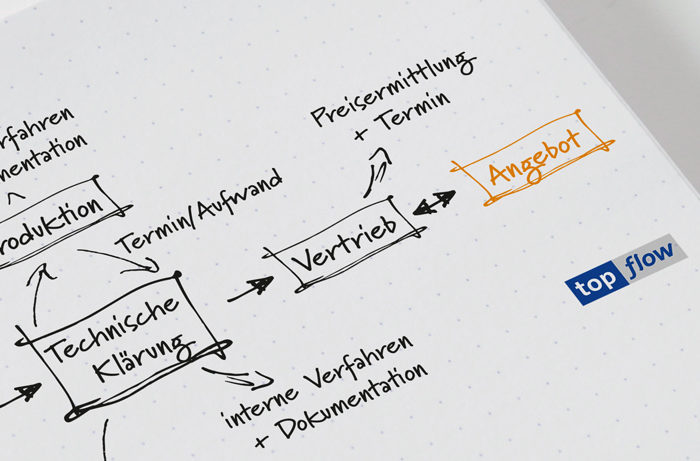
Business process management is first and foremost a method for process optimization. Only then do tools, i.e. technical solutions, come into play.
Business process management – the concept has been discussed for more than a decade, but it has not yet really arrived in practice. Especially not in SMEs. One reason for this is probably that many companies don’t really miss BPM – and don’t really know what it is and what it can do. Like so many things, however, this is also changing in the course of digitalization. After all, if you want to digitize your processes – and almost all companies do – you need to know them inside out. However, our experience in numerous projects shows that most companies only have a very vague idea of what their processes look like. Almost none of them are properly documented. This is precisely where BPM comes in and is therefore, to a certain extent, a necessary condition for successful digital transformation.
Method instead of technology
A second reason for the rejection of BPM is probably that business process management is often seen as a technological, tool-oriented task. If you want to introduce BPM at your company, you first need a solution – which requires a high investment and causes additional effort. However, this view is wrong or at least rather incomplete. Business Process Management is first and foremost a holistic method that focuses on processes. The aim is to design these efficiently and thereby reduce costs and save time without having to accept any loss of quality – quite the opposite. In any case, this requires precise knowledge of the various processes in the company. In concrete terms, this means breaking down the processes into their individual steps, putting them into a logical sequence – taking all dependencies into account – and assigning them to departments and/or people.
This first stage of methodically understood business process management alone is a real eye-opener for many companies. Because when processes are made transparent in this way, it quickly becomes clear where things are going wrong. For example, individual processes have been carried out in a certain way for years, simply because it has always been this way. However, this approach is not necessarily sensible or efficient. In projects, we also notice time and again that a process is handled differently by different people or departments. The participants notice this for the first time in a joint workshop. This individual interpretation of processes becomes a problem when potential synergies remain unused or communication with one another is made more difficult. In our experience, this is almost always the case.
WEBINAR
Establishing transparent production processes
Find out how you can bring more transparency to your production and uncover optimization potential.
Register for the webinar now
Introducing BPM pragmatically
BPM is worthwhile for every company – that can be said with a clear conscience. However, the question is with what effort and with which tools it is implemented. In our view, companies that have not yet gained any experience in this area should start pragmatically: Ideally, they should select a single process that they assume will bring tangible added value through digitization. There is usually a lot of potential in internal sales and purchasing processes. The selected process is discussed in a workshop and recorded graphically. No special BPM solution is required for this; PowerPoint, Word or a flipchart are sufficient. However, it is important that the process is really outlined in full and in detail. If there are different variants, these should also be recorded. The resulting process diagram depicts the current status and gives everyone involved – including external service providers – a good overview. The process can then be analyzed and re-modeled on this basis. The target state should also be depicted in a diagram. This forms the template for the implementation of the process and all further activities – for example, the introduction of IT solutions that support individual process steps or the entire process.

IT department as a driver
Once companies have gained initial BPM experience with individual projects, they can roll out the approach to all processes throughout the company. At this point, special BPM tools also become interesting. These provide a binding form of process representation, enable a very high level of detail and reduce costs in the medium term. It is often also possible to run through different target variants and compare them with each other.
The IT department has a crucial role to play in all of this – even if it is not primarily about the IT system. As a rule, it knows all the specialist departments well and can therefore guide the introduction and implementation of BPM in a targeted manner. In addition, IT itself benefits from properly recorded processes as soon as they need to be mapped on the system side.
You might also be interested in…
E-Book: The paperless office
In many companies today, there is still a lot of paper in circulation – despite the new possibilities offered by digitization. All of this is slowing down work processes.
With a well-integrated system, be it DMS, ECM or xRM, piles of paper can be reduced. Read more in the e-book.



