
 Overview
Process mining light: process optimization with top xRM

With top xRM, you can optimize your business processes without the need for time-consuming process mining.
How the software solution from top xRM focuses on processes
Alongside robotic process automation (RPA), process mining is currently the hot topic when it comes to process optimization. The fact that this relatively new approach is attracting so much attention is absolutely understandable. This is because it relies on new technologies to solve a well-known challenge: identifying weak points in business processes and thus reducing throughput times in particular. To do this, process mining software evaluates the transaction data stored in the IT system used by the company and reconstructs the actual business process from it. On the one hand, this is much faster than is possible with process consulting carried out by humans. On the other hand, the result is much more objective and meaningful.
Despite the considerable advantages, this approach is unlikely to be suitable for many small and medium-sized companies. This is mainly because the implementation of process mining is somewhat costly – and the effort is only worthwhile for rather complex processes.
Pragmatic process optimization
However, small and medium-sized companies do not have to do without analytics power altogether. We recommend a pragmatic approach to process optimization. Based on our top xRM solution. This is originally designed to digitalize processes in an SAP environment from end to end by linking enterprise content management, workflow management and collaboration components. This enables companies to map end-to-end processes, even if the SAP standard leaves gaps in some areas. As a result, all activities along a process are recorded, which is the basis for analyzing them.
The difference to process mining is that the basic structure of a process is not reconstructed from the data, but is already defined by the workflows set up. This is accompanied by a certain lack of clarity. This is because defined processes are often simply not adhered to for various reasons – and this is then the cause of ineffectiveness, inefficiency and a lack of transparency. Such deviations cannot be completely ruled out, even with top xRM. However, workflow management significantly reduces the opportunities for users to leave the defined process.
Dashboard provides an overview
As the process is therefore assumed to be given, it is simply a matter of relating the data for the individual activities to each other. If it is known when activity 1 starts and when the following activity 2 starts, this results in the lead time for this sub-process. The sum of the throughput times of all sub-processes shows how much time the entire end-to-end process takes. The results of all individual runs can be aggregated as required. This produces average values that are suitable for keeping an eye on developments over time. On the other hand, positive and negative outliers can be detected. And it is precisely from these that valuable findings can be drawn for process optimization.
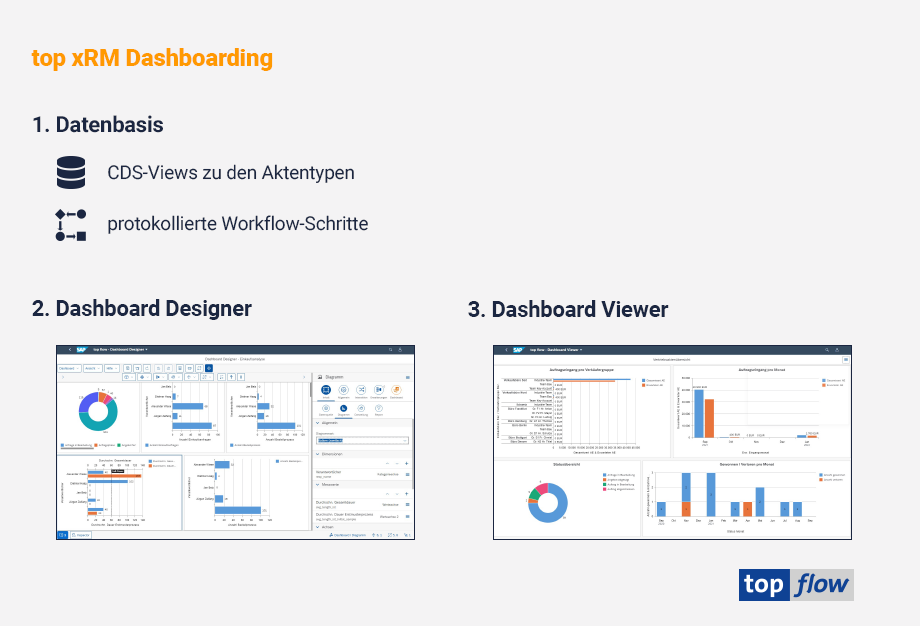
We have enhanced top xRM with a dashboard that makes it easy to generate and visualize key figures on process lead times. All header attributes of a file and all status information on the respective workflows serve as data sources. The dashboard as part of top xRM accesses this data stored in the SAP system using CDS views (Core Data Services). Which data is retrieved can be determined in the Dashboard Designer. Various filters can be activated there and simple date operations can be carried out. The key figures generated in this way are clearly displayed in the Dashboard Viewer. This makes it very easy to see, for example, how long a particular process takes on average and whether there are positive or negative deviations from this average value. If outliers are detected, it is possible to check whether certain factors regularly lead to a better or worse result. And this in turn is the basis for continuous improvement.