

 Overview
More automation for better quality
Alligator Ventilfabrik GmbH on the way to Industry 4.0

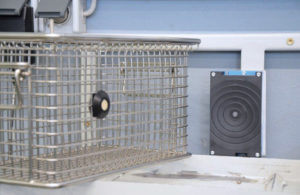
A read/write station for RFID data carriers - Alligator relies on the Manufacturing Execution System top MES.
Reliably maintaining the highest quality standards is a key task for the ALLIGATOR valve group. To achieve this efficiently, the company has introduced the Manufacturing Execution System top MES. The system was also the basis for the commissioning of smart cleaning systems – ALLIGATOR has thus successfully taken the first step towards Industry 4.0.
With their button in the ear, Steiff cuddly toys are known and loved by children and adults all over the world. ALLIGATOR valves are also a global household name. The company was founded in 1920 as a division of the then already established Margarete Steiff toy factory in the Swabian town of Giengen an der Brenz.
Project overview
The goals
- Ensuring the highest quality standards through greater transparency
- Increasing efficiency in production
- Eliminate errors in production
- Preparing the company for Industry 4.0
The solution
- Manufacturing Execution System
- Seamless integration into SAP ERP
- Combination with various software and hardware components
The benefit
- Guarantee of high quality standards
- Automated recording and transmission of operating and machine data in real time
- Creation of meaningful key figures as a basis for more efficient processes – such as Overall Equipment Effectiveness
- Self-controlling parts cleaning
ALLIGATOR grew in the following years, new locations were added and the product portfolio was constantly expanded. Today, in addition to valves for the automotive industry and other areas of application, the more than 600 employees also manufacture sensor solutions that monitor or manage tire pressure. Its more than 1,000 customers include renowned automotive and commercial vehicle manufacturers, automotive parts wholesalers, workshops and industry. In 2015, ALLIGATOR sold over one million parts per day and generated sales of around 65 million euros. This makes the company a global leader in its segment.
In most cases, the valves and sensor solutions are safety-relevant components on the vehicle. In this respect, it is a central task for ALLIGATOR to maintain the highest quality standards. And to ensure this, not only the end products are reliably checked. The individual production steps are also systematically and seamlessly checked.
Performance on the store floor should be optimized
In the past, however, the quality process was barely supported by the heterogeneous global IT landscape. ALLIGATOR therefore decided back in 2013 to replace the different systems with SAP ERP as a central solution. This enabled the integrated handling of all commercial business processes. At the same time, performance on the store floor was also to be optimized: Automate processes, eliminate errors in production and increase manufacturing quality to a maximum. “The processes in production in particular were not transparent,” says Hans-Jürgen Müller, Head of IT at the Steiff Group. “We didn’t have enough system-supported data. Until then, our basis was often data in paper form, which had to be manually transferred to Excel and maintained and managed there.”
However, the goal of transparent production – real-time production data and an overview of individual orders and shift assignments – could hardly be achieved by simply switching to SAP ERP. Hans-Jürgen Müller: “We therefore decided to add a Manufacturing Execution System to the newly introduced ERP solution.” The choice fell on top MES. The add-on extends the standard functional scope of SAP ERP with transparent production processes and can be fully integrated into the central SAP infrastructure without interfaces. After a rapid implementation, top MES has been in use since the beginning of 2014.
The highlights for ALLIGATOR
- top MES is directly integrated into SAP ERP. Interfaces are not required.
- The OEE cockpit makes it easy to record the situation on the store floor.
- top MES is the basis for further Industry 4.0 projects.
- SAP as the leading system
Since then, ALLIGATOR has been recording all operating and machine data with IT support. The information obtained in this way is available for analysis in the OEE cockpit (Overall Equipment Effectiveness). “This has enabled us to optimize our production and increase its efficiency through transparent data flows,” says Manfred Wiedenmann, Project Manager at ALLIGATOR. As the MES obtains all data on production orders, materials and quantities directly from the SAP system without interfaces and subsystems and writes the production progress back to it, it also provides a reliable basis for calculations. This is an important success factor for being able to hold its own as the global market leader for valves against strong competition from the Far East.
RFID-enabled cleaning systems are introduced
After SAP ERP and top MES proved their worth at the German plant in Giengen, they were also introduced at the Polish site at the beginning of 2015. Manfred Wiedenmann: “We also decided to work with top flow to expand our IT infrastructure in the direction of Industry 4.0.” Specifically, this meant putting two RFID-capable (Radio Frequency Identification) cleaning systems into operation and connecting them directly to SAP ERP. “In this way, we wanted to kill two birds with one stone. On the one hand, we wanted to replace our outdated machines, and on the other, we wanted to meet our customers’ requirements for better cleaning quality of our end products,” says Manfred Wiedenmann.
The Manufacturing Execution System that had already been introduced played an important role in the Industry 4.0 project, as it is used to map and control the process: The finished components from machining end up in a container fitted with an RFID data carrier. A top MES function is used to write all relevant data on the component and the production process directly from SAP ERP to the RFID data carrier. This includes, for example, the order and material number, date and quantity as well as the washing program for the corresponding part cleaning. At the cleaning system, sensors at dedicated read/write stations read the information from the RFID tag and run the cleaning process specific to the incoming component fully automatically. After the cycle, the components are automatically transferred to a new container and the weight is determined. All information from container 1 is transferred to the new container 2 and its RFID data carrier. In this way, the weight of the cleaned components can be precisely determined and transferred back to SAP ERP via top MES. At the same time, the weight is converted into exact quantities using the individual piece weights stored in the SAP system, thereby documenting the production progress on the IT side. The work in progress is therefore digitally marked and can also be digitally identified at any time during transportation and interim storage.
Software and hardware had to be coordinated
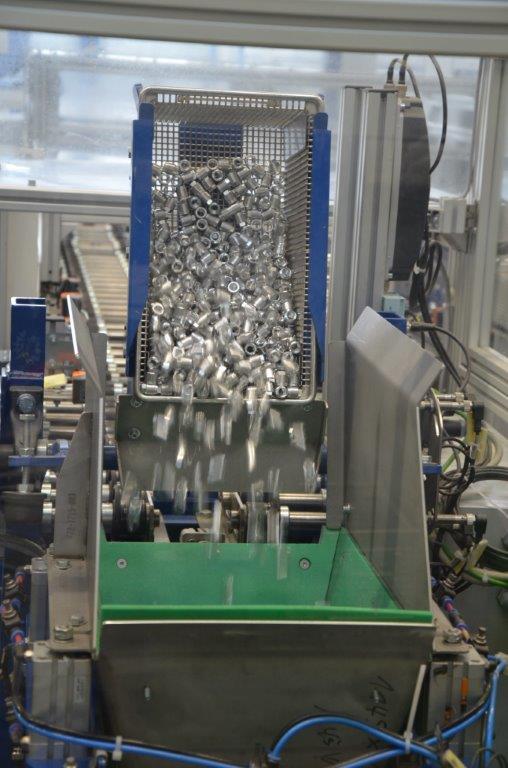
Cleaned components are weighed automatically
However, a number of challenges had to be overcome before this process could be established. The central task was to coordinate all software and hardware components so that the data flow from SAP ERP to the data carrier on the container, from the data carrier to the machine and back again would function smoothly. ALLIGATOR was responsible for the coordination – in cooperation with top flow and SAP, among others. In addition, a detailed exchange of information with the suppliers and service providers involved was required. Finally, it was necessary to find suitable containers and correspondingly resistant RFID data carriers. These had to be very heat-resistant and suitable for use with environmentally friendly cleaning agents. “Together with top flow, we were able to overcome all the hurdles in this follow-up project and achieve a fully automated solution,” says Manfred Wiedenmann.
Production Manager at ALLIGATOR Robert Binder adds: “By eliminating manual activities, our production process becomes even more efficient. As an innovative automotive supplier, we consistently focus on self-controlling production. With the seamless integration of our cleaning systems, we are taking an important step towards Industry 4.0. This will enable us to successfully maintain our leading position in international competition and secure our headquarters in Germany in the long term.”
“By eliminating manual activities, our production process becomes even more efficient. As an innovative automotive supplier, we consistently focus on self-controlling production. With the seamless integration of our cleaning systems, we are taking an important step towards Industry 4.0.”
Robert Binder, Production Manager at ALLIGATOR”
About ALLIGATOR valve group
Location: Giengen an der Brenz (headquarters)
Portfolio: Valve technology and sensor solutions
Turnover: 165 million euros (2015)
Employees: 600 worldwide (2015)
Internet: www.alligator-ventilfabrik.de
Status as of November 2016
Success Story top MES – ALLIGATOR Ventilgruppe


