

 Overview
Mobile production data acquisition in real time
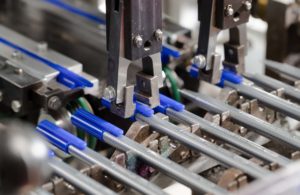
Staedtler relies on top MES from top flow for production data acquisition.
The renowned stationery manufacturer Staedtler relies on digital support to plan employees, machines and materials even more precisely and to map production costs even more accurately. Since 2016, the Franconians have been recording production data with top MES and the integrated production data acquisition system.
Project overview
The goals
- Record central operating data digitally and on the move
- Meaningful actual data on quantities, personnel and machine times to improve planning data
- Laying the foundation for further digitization steps
- Seamless implementation in customer-specific SAP environment
The solution
- PDC of the Manufacturing Execution System top MES
- Integrated in SAP ERP, no interfaces required
- Gradual introduction at all production sites and expansion
The benefit
- Reduced effort thanks to decentralized recording, transmission and documentation of operating data
- KPIs to increase productivity
For many decades, there has hardly been a classroom, children’s room or office where they are not to be found: Pencils, erasers, fine leads or modeling compounds from Staedtler. The products of the traditional Franconian company are a natural part of the everyday lives of millions of people. They are used as work or creative tools, as toys and as learning aids. Staedtler manufactures almost two thirds of its products for the global market at its German sites. Staedtler has worked hard to achieve the brand’s high level of international recognition and the equally high quality expectations of its customers. Founded in Nuremberg in 1835, the company has constantly developed new product ideas and innovative production processes. And even if the name Staedtler stands for classic analog products: The Nuremberg-based company recognized the opportunities of digitalization early on and gradually digitalized and automated its processes. Nevertheless, there are still gaps on the road to digitalization at the three German production sites.
Time and quantity data with delay
At the plastics competence center in Sugenheim, plastic parts for fineliners are produced by injection moulding and erasers, coloured and graphite pencils by extrusion. A high degree of automation and high hourly output are essential in order to remain competitive despite production in Germany as a high-wage location. Gudula Schmidt-Henne, responsible for global information technology in the areas of production, logistics and quality management: “Speed also counts for us! We promise our sales branches and wholesalers worldwide delivery within 48 hours.”
Flexibility is required for this demand-oriented production. And the ability to finely control production and the use of materials and personnel. Previously, however, this required a great deal of manual effort. Quantity values as well as set-up times and processing times were recorded manually on the store floor. Only once a day did workshop clerks transfer the data from the three shifts of a day to SAP ERP. Meaningful actual data therefore only ended up in the system with a time delay.
Difficult planning of personnel and machines
The target data required for planning and controlling came solely from a REFA time recording. The quantity to be achieved was specified in SAP ERP and the system used this to calculate target times. Gudula Schmidt-Henne: “The REFA work schedules showed, for example, that the setter needs an average of four hours to get a machine ready for use and that it then has to run for 20 hours to produce a certain part 100,000 times. However, the REFA data was relatively imprecise in relation to the individual order. This is because specifications for processes with deviating conditions were derived from a snapshot with certain conditions.”
The highlights for Staedtler
- SAP ERP remains the leading system throughout the company.
- BDE from top MES is integrated into SAP without interfaces.
- Mobile BDE uses meaningful dialogs for easy use on the store floor.
- Planning and production benefit from reliable actual data.
- top MES is the basis for further Industry 4.0 projects.
Production planning is particularly complex in injection molding: the different product groups, such as fineliners, markers or mechanical pencils, are assigned to different planners. However, all of these products require plastic parts from injection molding. If, for example, felt-tip pen model X with a thick writing tip is needed, the responsible MRP controller must schedule his order between the orders of the other MRP controllers. Theoretically, they all have access to 50 injection molding machines with 250 different molds and numerous employees at the same time. Without reliable target values for the personnel and machine times, this task can hardly be completed with maximum efficiency – and the previous process provided too imprecise support for this.
Integrated and mobile production data acquisition
In addition, time-consuming monitoring and booking of personnel and machine times in injection molding production was required. This is because the employees on the store floor are responsible for several machines and production processes in parallel – but ideally their times should be allocated to individual orders. “In Sugenheim, we therefore decided to become more digital with an MES (Manufacturing Execution System). Our aim was to have simple processes in which the actual times and quantity values are recorded directly in production and entered promptly into the SAP system,” says Gudula Schmidt-Henne.
In the other German plants, in Nuremberg and Neumarkt, the project manager also asked about the interest and requirements on site. Many manufacturers of injection molding machines supply their own MES. However, this cannot be extended to other processes and it is not optimally connected to SAP. “However, we wanted a solution for production data acquisition integrated into the ERP, which would also leave us open to subsequent fine control or machine connection.” Staedtler also expected the new PDC system to run on mobile devices via web apps. Schmidt-Henne: “Our employees should not be tied to PCs or terminals at work, but should be able to use the PDA wherever they are working.”
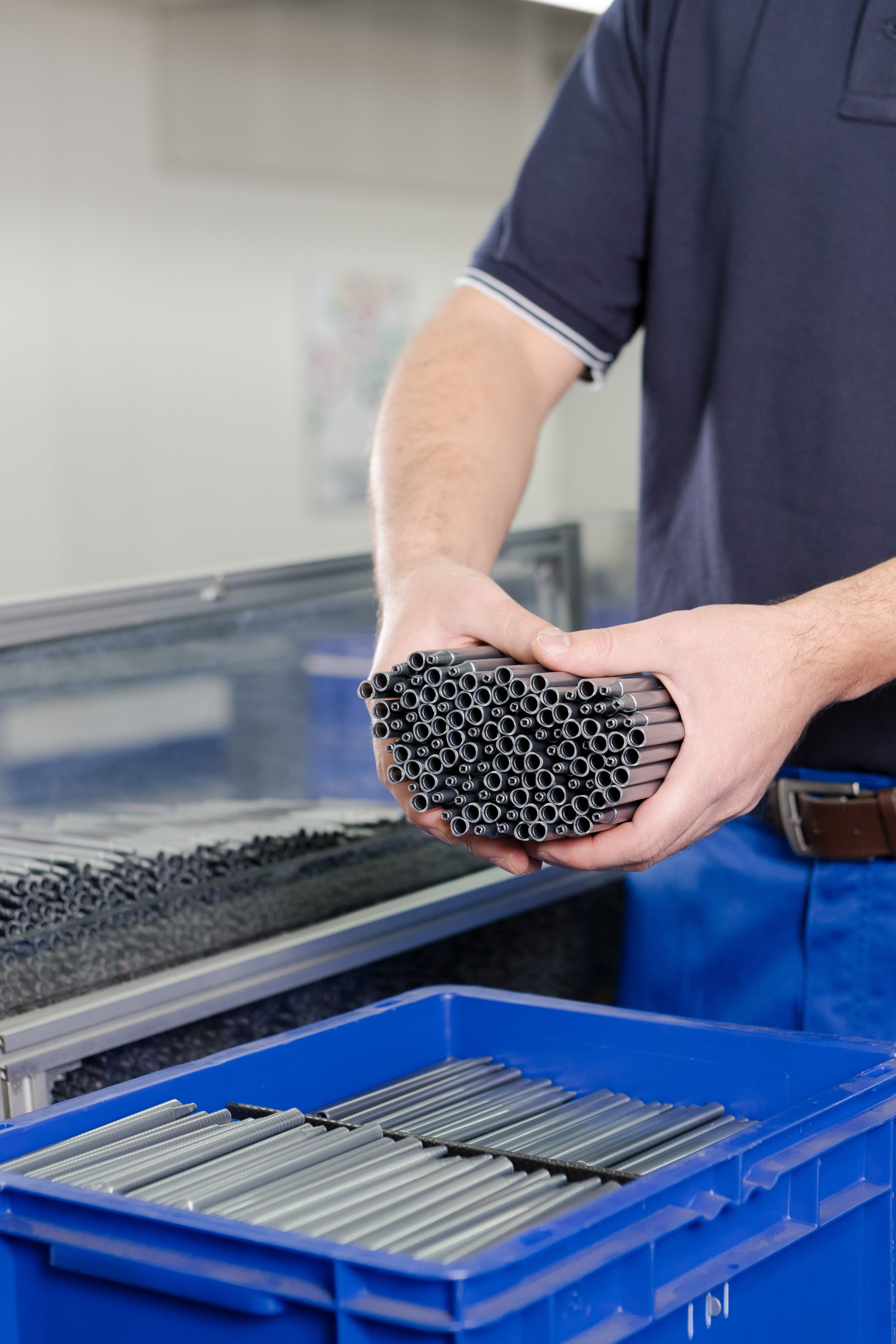
The injection-molded shafts are produced as required and sent to the assembly line.
Employees benefit from the simplicity of the system
Staedtler quickly opted for top MES from top flow. On the one hand, this was due to the interface-free and flexible modular system, which can be easily expanded at a later date. Another was the user-friendly interface of the integrated PDA solution: “Our employees operate up to ten different machines per shift. They now use smartphones to scan a barcode on the machine and can then directly record quantity data, book set-up times or log in and out. The special thing about this is that the colleagues tested the interface intensively and incorporated their feedback into the development,” says the project manager. As a result, the dialogs are based on real work processes. This was a great advantage, as some colleagues on the store floor had hardly any previous experience with smartphones.
In day-to-day operations, employees are much more autonomous thanks to mobile production data collection. For example, an adjuster can decide at short notice whether to take on the role of a machine operator and produce parts. He automatically records his times in the correct cost type via smartphone. In addition to such functions, Staedtler is also impressed by the speed of top MES. Gudula Schmidt-Henne: “As we have many simultaneous PDC accesses, we benefit from the system’s asynchronous data processing. This makes operation extremely fast and reliable.”
“Thanks to mobile production data acquisition, our production planning now has reliable data. This enables us to keep our delivery promise even better and detect bottlenecks in production even faster.” Gudula Schmidt-Henne, Global Information Technology and Enterprise Applications at Staedtler
Better capacity utilization and planning
The recorded data is available immediately: “This allows us to call up relevant production values directly – at the end of a shift, for example – such as quantities, employee times, wage types and more,” says project manager Schmidt-Henne. The meaningful actual data ultimately also benefits planning. For example, Staedtler now knows that the set-up times for certain orders are on average 30 minutes shorter than previously thought. In injection moulding, this information leads to noticeably more precise order planning and more efficient utilization of people and machines.
Staedtler is now also working on determining overall equipment effectiveness (OEE) as a key performance indicator. “The performance of our machines is an important indicator for us to recognize how well the equipment is working and where possible losses lead to bottlenecks,” says Schmidt-Henne. Her conclusion is correspondingly positive: “The cooperation with top flow has been perfect so far: all agreements were kept, support was available when we needed it and the consultants immediately understood what was important to us. This is another reason why we are planning the future with top flow.”
STAEDTLER Mars GmbH & Co KG
- Location: Nuremberg (Headquarters)
- Portfolio: Writing, painting, drawing and creative products
- Turnover: approx. 364 million euros (2018)
- Foundation: 1835
- Employees: 3,000 worldwide (2019)
- Internet: www.staedtler.com
Success Story top MES – STAEDTLER Mars GmbH & Co. KG


