

 Overview
Cost transparency in medium-sized manufacturing companies
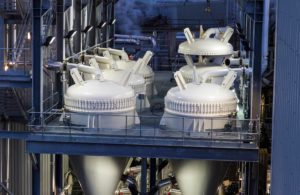
With top flow's production data acquisition, Putsch ensures cost transparency in the work process.
After switching to the ERP system from SAP, machine and plant manufacturer Putsch took the next step to make the costs of its production processes more transparent. In less than six months, the long-established company implemented the production data acquisition system from top MES and has since benefited from meaningful data for target/actual comparisons.
Almost 200 million tons of sugar are produced worldwide every year. Factories and refineries process sugar beet and sugar cane in particular in a multi-stage process. Putsch GmbH, based in Hagen, Westphalia, has been successfully developing and constructing machines and systems for the global market for over 140 years. Putsch also plans and builds entire sugar factories and sugar refineries. However, the international leadership position is a continuous challenge for the company.
Project overview
The goals
- Record all operating data digitally, document all production processes digitally
- Gain meaningful key figures to determine and analyze costs and production times
- Laying the foundation for further digitization steps
- Seamless implementation in customer-specific SAP environment
The solution
- PDC of the Manufacturing Execution System top MES
- Integrated in SAP ERP, no interfaces required
- Gradual introduction at all production sites
The benefit
- Reduced effort thanks to automated recording, transmission and documentation of operating data in real time
- Accurate and consistent information for costing and profitability
- Increased transparency on quality and productivity in production
Putsch masters them because the long-established company focuses on innovation and the highest quality standards in all areas. “We can’t compete on price in the long term. But our systems ensure extremely efficient manufacturing processes and the best end products,” says Alexandros Georgiou, Head of the IT department. For example, a high sugar yield can only be ensured if the washed sugar beet is cut into the most precise, V-shaped cossettes possible by cutting machines before drying. Fast and consistently precise.
Complex distribution of labor costs
The main plant in Wuppertal manufactures drum cutting machines, press chamber filters for wet/liquid separation and other machines, systems and tools. When the previous ERP system was replaced by the more powerful SAP ERP in 2013, a digital production data acquisition (PDA) system with standard SAP components was also to be introduced in order to record all time events. However, it quickly became apparent that the PDC postings and transactions via SAP CO19 could not be sufficiently adapted to Putsch’s requirements.
For example, the system was unable to automatically record multiple machine bookings. Alexandros Georgiou remembers: “If a worker was working on three machines at the same time, he would log on to all three machines and log off again after perhaps five hours of work. In the automatic evaluation, however, the machine times were added together and resulted in a nonsensical 15 hours of worker time.” In order to obtain at least limited usable data later, the times were entered manually in the ERP.
Too little insight into production data
In addition, the data was hardly suitable for determining optimal machine utilization or material consumption. Particularly in the production of complex machines, when different, sometimes parallel production processes are to result in a joint product, problems arose if a required part had not yet been fully produced. As a result, some delivery dates could only be met with difficulty. This was because production lacked the ability to determine the progress of work and orders – or possible production backlogs – at an early stage.
The highlights for Putsch
- SAP ERP remains the leading system.
- BDE from top MES is integrated into SAP without interfaces.
- top MES offers customizable dialogs for easy use on the store floor.
- Controlling, planning and sales benefit from transparent actual data.
- top MES is the basis for further Industry 4.0 projects.
The lack of transparency also caused little enthusiasm in Putsch’s controlling department: “Without real and reliable worker times, it was incredibly difficult to determine the exact costs for the production of a machine or system. We simply lacked the data basis for consistent target/actual comparisons and timely profitability analyses,” says Alexandros Georgiou. Ultimately, this lack also had an impact on other areas, such as budget planning or precise costing in quotations.
A solution for SMEs
At the end of 2015, the time had come for Putsch to take a more fundamental approach to the topic. The goal: a PDA solution that did away with the compromises that were necessary with the standard SAP components. At the same time, SAP should of course remain the leading system. “That’s why we concentrated on providers whose PDC can be seamlessly integrated into SAP,” says Alexandros Georgiou. Starting at the main plant in Hagen, Putsch wanted to map all production processes using the new PDC. An absolutely user-friendly terminal interface was important to the IT manager and his colleagues. Georgiou: “We knew that our transparency goals could only be achieved if the workers enjoyed using the terminals and did not make any operating errors.”
Discussions were soon held with potential providers. The production data acquisition system from top flow, which is based on top MES, was also shortlisted because it can be integrated into SAP ERP without any interfaces. “In our contact with top flow, we were also impressed by how quickly the consultants understood us as a medium-sized and international company. After a one-day workshop, we already had a specification sheet – with suitable solution proposals for our specific requirements,” says Georgiou. This was the final decision in favor of the PDC from top flow.
Employees always involved
Putsch started the implementation in April 2016. The implementation of the specifications ran smoothly – even if some individual function or dialog adjustments were necessary. Project manager Georgiou looks back with satisfaction: “Our contacts at top flow were immediately available and drove the project forward creatively. This meant that the system in Hagen was fully operational after just over five months.” By this time, the employees had also completed their training. “We attached great importance to clear terminal dialogs and a user interface that everyone could understand. The training effort was minimal.”
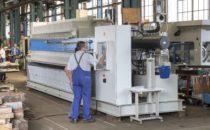
Putsch now also records meaningful operating data in the ERP for its filter presses for solid/liquid separation.
Putsch dispelled any reservations that employees would now be monitored in advance. Together with the works council, comprehensive information was provided on how the PDA works and what data is used for what purpose. When a worker starts a production order, he enters his time card number and what is to be assembled via the terminal on the machine. In the same way, the system records interruptions, the end of production or set-up times and books them in the ERP. The quantities produced and therefore the production progress and component consumption are also recorded via the time recording system.
“Thanks to the production data acquisition from top MES, we now have much more insight into our cost distribution: we can finally record and evaluate worker and set-up times, material consumption and production quantities in real time,”
Alexandros Georgiou, Head of the IT department at Putsch
Transparent costs for better calculation
The new main production site in Wuppertal has also long since been connected to the system. This means that the company also benefits from real and reliable data from production here: “We now analyze our production much more deeply and precisely than before. The production progress during an order – and the costs in the value creation process,” says Alexandros Georgiou. With each recorded production run, the database becomes even broader and more meaningful. Production quantities, component consumption, time usage or target/actual comparisons are evaluated in detail at Putsch and incorporated into the planning process.
This also benefits other areas, says Georgiou: “On the one hand, our work preparation and project teams now have planning data that ensures optimized adherence to deadlines. Secondly, quotations are based on better values and we can calculate more accurately.” The IT manager is correspondingly pleased that an expandable system has been installed with the production data acquisition from top MES: “We are already using the terminals to provide employees with clamping plans and other production-relevant documents. And we want to gradually integrate further production areas.”
The company – Putsch GmbH & Co KG
- Location: Hagen (Headquarters)
- Portfolio: Planning and construction of sugar factories and sugar refineries
- Foundation: 1871
- Employees: approx. 500 worldwide (2018)
- Internet: www.putsch.com
Success Story top MES – Putsch GmbH & Co. KG


