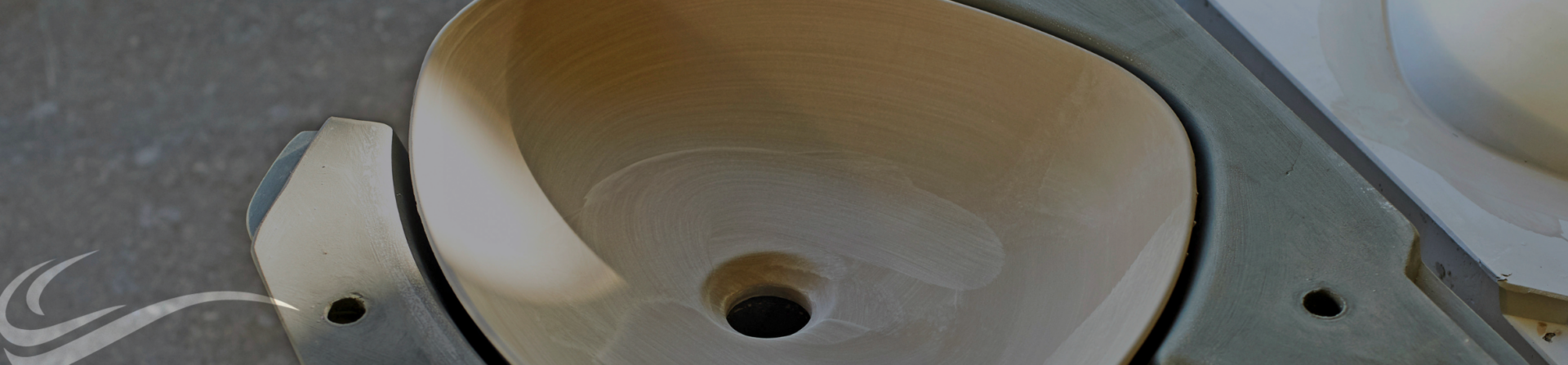
With the self-image of a premium manufacturer of internationally sought-after sanitary products, Duravit AG pays attention to the highest product quality. In order to keep this promise even better, the company has been relying on the Manufacturing Execution System top MES for some time now.
Founded in 1817 as a stoneware factory by Georg Friedrich Horn, the Black Forest-based company Duravit now develops, produces and sells sanitary ceramics, bathroom furniture, shower trays and bathtubs, wellness systems and fittings worldwide. It employs around 7,000 people worldwide and currently produces its award-winning bathroom designs in ten international production facilities. The company’s key secrets to success include excellent product quality and a high level of innovation. To ensure this in the long term, the company constantly invests in product development and in the combination of state-of-the-art production technologies and high-quality craftsmanship.
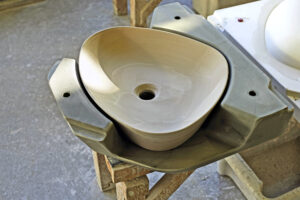
Why this is necessary is demonstrated by the complex production processes, which – in the case of a washbasin, for example – involve up to three stages:
“Production is very energy and cost-intensive due to firing in the kiln and is also susceptible to faults, as ceramics are generally sensitive to external influences. Efficient production processes and early quality control are therefore decisive competitive factors for us,” explains Marc Schmidt, SAP PP Inhouse Consultant at Duravit.
It has therefore long been important for Duravit to exploit optimization potential. As part of the upcoming SAP S/4HANA transition, the company quickly realized that data collection in production would be very time-consuming with the planned SAP processes and therefore decided to introduce a modern MES at the same time.
And so Duravit began the search for a suitable solution, initially to establish it in the Meißen and Hornberg plants and then to use it as a template for other sites. Those responsible at Duravit defined the central criteria for the desired MES system:
During its search, the company came across top MES – the SAP add-on from IT specialist top flow. From the outset, top MES impressed Duravit with its interface-free SAP connection, which can be adapted very flexibly to the requirements of production. In addition, there were very clear recommendations from some of the company’s partners who had already worked with top flow in the past. And so the ceramics specialist finally contacted the software developers from Bad Saulgau to sound out a possible collaboration. Those responsible quickly agreed on a promising approach.
This began with an as-is analysis of the existing processes and the underlying IT structures. One particular focus of the joint project team formed for this purpose was to digitize paper-based processes, record quality data promptly – preferably in real time – and ensure greater transparency.
To this end, the project team initiated several measures based on the top MES introduction, in particular:
1) The introduction of a ceramic barcode
In the Meißen and Hornberg plants, production was often still “on call”. The workers received important product characteristics on paper and also recorded their own performance on paper. This data was then transferred downstream to the ERP system by plant recorders. Up-to-date evaluations were therefore not possible.
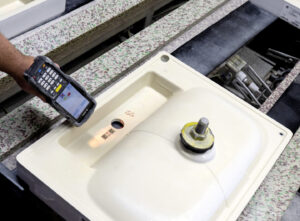
The introduction of top MES has now put an end to these manual processes. To this end, the project team introduced a special serial number, the so-called “ceramic barcode”, as a new, unique identification key for each individual product. This is attached to the individual piece during casting and finally fired in the tunnel kiln:
Employees on the store floor can now simply scan this and automatically receive all the information required for the next production step (such as technical specifications) in digital form.
In the background, the code is also linked to the key SAP objects, such as the order number and the previous goods movement. For production control, this means that the location and processing status of the individual product is transparent at all times. For production planning and control in particular, this new clarity brings significant benefits – partly because the necessary evaluations are now available in real time.
2) The use of handhelds in production
In order to make practical use of the ceramic barcode, Duravit equipped its employees on the store floor with mobile handhelds, tablets or IPCs. The production plants also received a heat-resistant WLAN infrastructure that can withstand even the high temperatures near the kiln – up to 45 degrees Celsius.
3) Rapid quality control and continuous improvements
Rapid error corrections and continuous process optimizations are an important success factor for Duravit due to the very sensitive ceramics. Workers can now use handheld devices to report production performance and product defects at an early stage. Top MES also opens up completely new controlling options that go far beyond real-time error reporting. For example, the system constantly collects data in the background about where reject rates and defects occur. This enables the company to narrow down and eliminate possible causes much more quickly – for example by training staff or maintaining unreliable machines or molds.
4) The retrograde booking of processing times
A final feature concerns the recording of working hours. Due to various interface problems, Duravit was still doing this manually at the Hornberg and Meißen plants until the new MES was launched: The employees recorded the quantities produced using tally sheets, which were later compared with the working times stored in the HR system and distributed to the individual cost centers according to a specific key, which also includes set-up and ancillary activities. By digitally recording the work steps on the production orders, this is no longer necessary. Instead, this process is now fully automated. A brief check and confirmation by the foreman on the following day are sufficient.
After intensive project work, Duravit put top MES into productive operation in both Meißen and Hornberg. In the long term, the company expects the new solution to provide greater transparency and predictability, fewer errors and greater cost efficiency overall. Duravit AG would also like to gradually roll out top MES at other company sites so that they can also benefit from it. Marc Schmidt is extremely satisfied with the results so far:
“With top MES, we now have a modern and highly flexible manufacturing execution system. And thanks to the excellent collaboration with top flow, we have been able to comprehensively digitalize existing processes. This now also serves as a template for other locations. The next step will be our new plant in Canada. We will be very happy to rely on top flow’s support again for this!”
“With top MES, we have made ourselves future-proof in many respects: We now use a highly flexible system that reduces our production costs, increases quality and enables us to implement new processes.”
Marc Schmidt, SAP PP Inhouse Consultant at Duravit
Location: Hornberg in the Black Forest
Product Line: Plumbing fixtures and ceramics—e.g., bathroom furniture, faucets, and accessories
Revenue: approx. 604 million euros (2022)
Employees: approx. 7,000
Website: www.duravit.de

top flow GmbH


